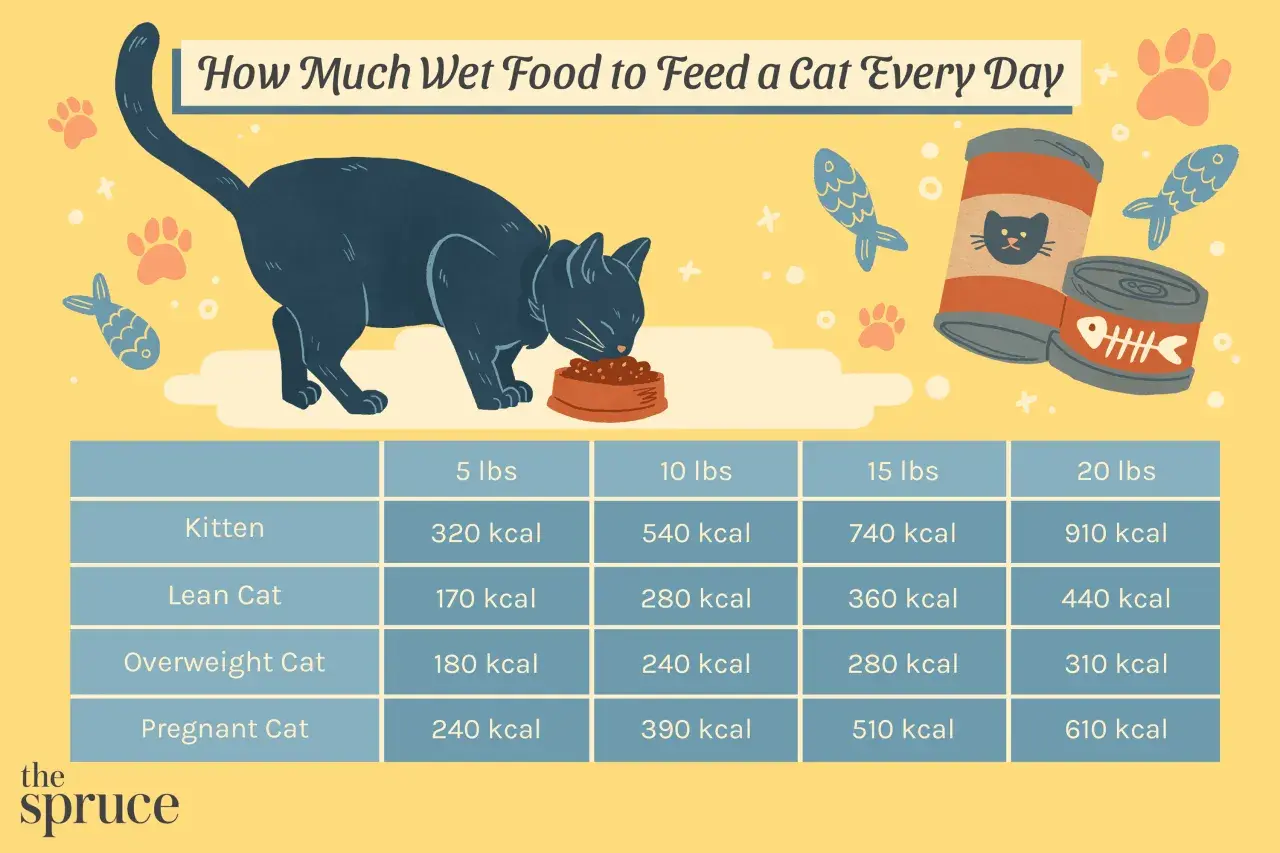
Feeding wet food gets much easier once you stop thinking in tins and start thinking in calories. The real answer to how much wet food to feed a cat depends on body weight, body condition, age, activity, and the calorie density printed on the label. In this guide, I’ll show you a realistic starting point, how to convert it into pouches or grams, and when to change the amount.
The right portion starts with calories, not package size
- Start with a calorie target first. A pouch size alone tells you very little.
- A healthy adult cat often needs about 200-290 kcal per day. A 3 kg cat usually starts around 200-210 kcal, a 4 kg cat around 225-250 kcal, and a 5 kg cat around 250-290 kcal.
- Only complete food can stand alone as the full diet. Complementary food is not a full daily ration.
- Use the label, then adjust for the cat in front of you. Age, neutering, activity, and health all matter.
- Weight checks are the best reality check. If the cat is gaining or losing, the portion needs a reset.
Calories are the real portion size
I start here because wet food labels can be deceptive. Two foods can weigh the same and still deliver very different amounts of energy, which is why a “pouch count” is only useful after you know the calories inside it.
A practical starting point for a healthy adult cat in ideal body condition is around 200-210 kcal/day for 3 kg, 225-250 kcal/day for 4 kg, and 250-290 kcal/day for 5 kg. That is a baseline, not a permanent prescription, because some cats run lean and active while others need a tighter ration.
If the food is labelled as complete, it can be used as the main diet. If it is only complementary, it belongs in the diet as an extra, not as the whole meal plan. Once you accept that calories, not container size, drive the portion, the rest becomes much more straightforward.

A practical starting point by body weight
| Cat weight | Starting calories per day | Approx. 85g pouches per day* |
|---|---|---|
| 3 kg | 200-210 kcal | About 2.5-3 pouches |
| 4 kg | 225-250 kcal | About 3-3.5 pouches |
| 5 kg | 250-290 kcal | About 3-4 pouches |
*Example only. This table assumes a pouch is roughly 80 kcal. If your food is 65 kcal per pouch, the cat needs more pouches. If it is 95 kcal per pouch, the number drops. That is why I always read the kcal line before I trust the serving guide on the front of the pack.
If your cat is much smaller, much heavier, or clearly overweight, use the calorie formula below rather than copying a pouch count from a table. The next step is turning the label into a daily ration you can actually measure.
How I would calculate the daily ration from any label
The formula is simple: daily calories needed ÷ calories per pouch or can = daily portions. I prefer that approach because it works with any brand, any texture, and any pack size.
- Find the kcal value on the pack. Use kcal per pouch, per tray, per can, or per 100g if that is how the food is labelled.
- Set a daily calorie target for the cat. Weight and body condition come first, not appetite.
- Divide the target by the calories in the food. For example, 240 kcal/day divided by an 80 kcal pouch equals 3 pouches.
- Split the total into meals. I usually prefer at least two meals for adults and smaller, more frequent meals for kittens.
- Count treats and any dry food in the total, because those calories do not disappear just because they were offered separately.
That calculation is the most reliable way to make feeding feel less like guesswork. Once you can do it on paper, the bigger question becomes who needs a different target in the first place.
Kittens, adults and seniors do not eat the same way
Age changes the ration more than many owners expect. Kittens need more energy per kilogram and usually do better with several smaller meals, because their stomachs are small and their growth demands are high.
Neutered adults often need less than intact cats, especially if they live indoors and move less. Senior cats are a mixed case: some need fewer calories because activity drops, while others need enough energy and protein to protect muscle. Age alone does not tell you which side your cat falls on, so I pay attention to body shape as much as the date on the passport.
Pregnant and lactating cats are the exception I would never guess at. Their needs can rise sharply, and a normal adult feeding plan may be too small very quickly.
The pattern is simple: growth, reproduction, neutering, and activity all shift the daily need. That is why a portion that looked right six months ago can quietly become wrong now.
Health changes matter more than the packet
When a cat has a medical issue, I stop treating the label as the final word. Kidney disease, diabetes, urinary problems, dental pain, and digestive trouble can all change appetite, calorie needs, or the best food choice. Wet food often helps with hydration, but it still has to fit the cat’s medical plan.
This is where body condition score becomes useful. It is a structured way to assess fat cover, usually on a 9-point scale, and it is far better than judging by appearance alone. I also pay attention to muscle condition, because a cat can lose muscle even when the scale barely moves.
If your cat suddenly eats more, eats less, or loses weight without trying, I would not wait for the next bag to run out. That is the moment to reassess the plan, not to keep feeding by habit. Once the health picture is clear, you can decide whether the cat should stay on wet-only feeding, move to a mixed plan, or follow a vet-directed diet.
Wet-only feeding and mixed feeding are not the same problem
A cat on wet-only feeding gets every calorie from the wet food itself, so the label has to cover the whole day. In a mixed plan, I count wet food, dry food, and treats together, because the cat does not care where the calories come from, only that they add up.
Here is the simplest example. If your cat needs 240 kcal/day and you feed two wet meals worth 80 kcal each, you have already used 160 kcal. The remaining 80 kcal could come from dry food, but only if you actually measure it. Free-pouring kibble is one of the easiest ways to create gradual weight gain.
Wet food has a practical advantage because it is easy to portion and usually supports hydration better than dry food. I like that for picky eaters and for cats that need more moisture in the diet, but hydration should not make anyone sloppy with the total calorie count.
If you use treats, keep them small and count them inside the daily budget. A treat should be a detail, not a second dinner.
The signs the portion is wrong
- Too much food: the waist disappears, the ribs are harder to feel, weight creeps up, or the body starts to look rounder from above.
- Too little food: the ribs or spine become too obvious, weight falls, or energy drops even though the cat seems hungry.
- The food does not suit the cat: vomiting, diarrhoea, constipation, or messy eating can point to a formula, texture, or feeding-pattern problem.
- The feeding rhythm is off: the cat begs constantly, acts frantic at mealtimes, or leaves food because the portions are too large at once.
I prefer a monthly weigh-in for adult cats and a quicker check if the cat is being managed for weight loss or weight gain. If the scale moves in the wrong direction for two or three weeks, the plan needs a reset. The cat’s body is the best feedback you have.
The feeding routine I would use in a real home
My default routine is simple, and that is exactly why it works: choose a complete wet food, read the kcal figure on the label, set a daily calorie target, divide it into measured meals, and re-check the amount whenever the cat’s weight or activity changes.
- Weigh the cat every month, not only when something looks obviously wrong.
- Use the same measuring method every day, whether that is a kitchen scale or counted pouches.
- Recalculate whenever you switch brands, because calorie density can change a lot.
- Adjust after neutering, illness, or a big shift in activity.
- Ask a vet promptly if the cat suddenly stops eating, starts eating much more, or loses weight without trying.
The best feeding plan is the one that stays accurate in the real world, not the one that only looks neat on paper. If you keep the focus on calories, body condition, and label reading, the question stops being guesswork and becomes routine.
