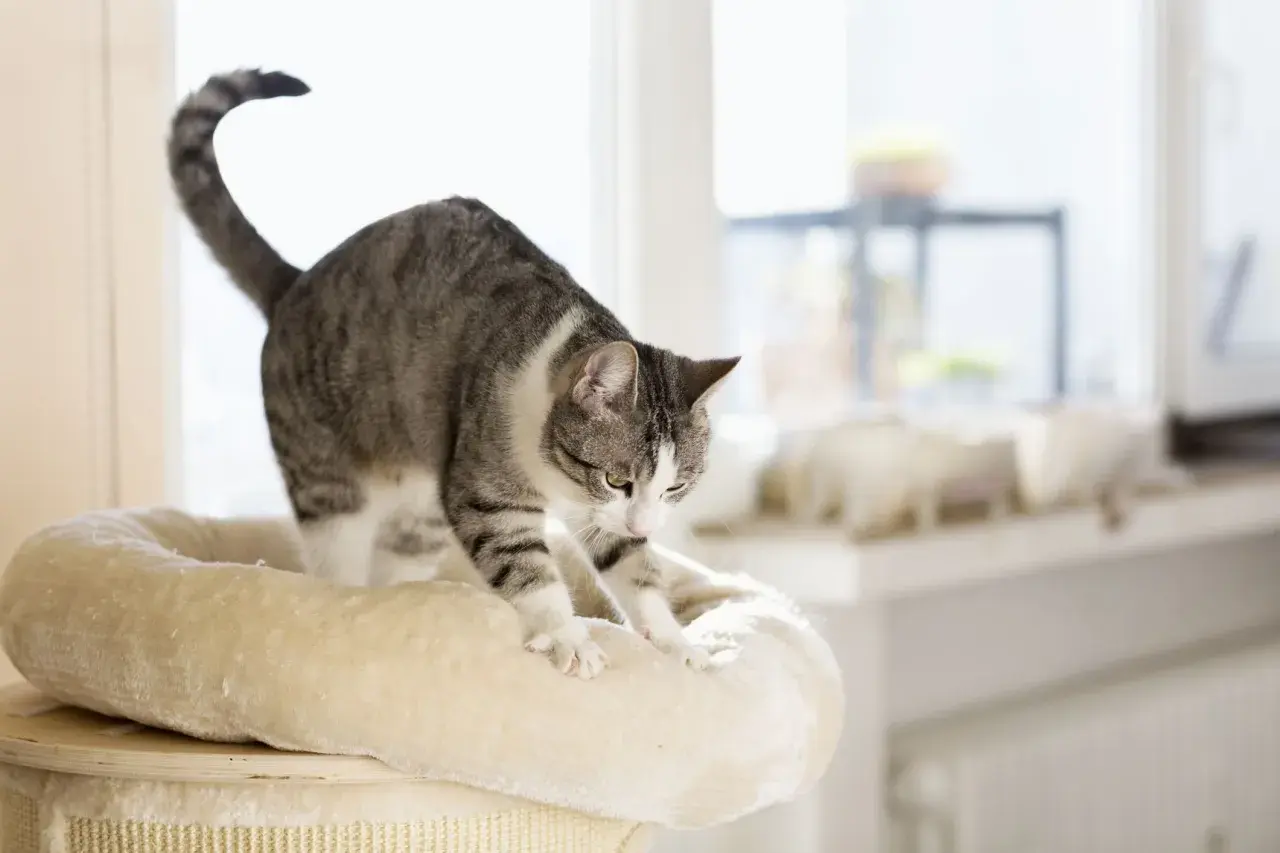
Kneading is one of the clearest signs that a cat feels settled around you, but it can also leave your legs covered in tiny claw marks if you do not know how to manage it. The short answer is that your cat is usually relaxed, bonded, and following an instinct that starts in kittenhood. In this guide, I break down what the behaviour means, how to read the rest of the body language, and how to make lap time more comfortable for both of you.
What kneading usually means
- Kneading usually begins as a kitten habit linked to nursing and comfort.
- When a cat does it on you, the usual message is trust, relaxation, and social bonding.
- Purring, slow blinking, and a loose body make the signal stronger; tense ears or tail flicking change the meaning.
- A thick blanket and regular claw care make lap kneading much easier to live with.
- Sudden changes in the habit, especially with hiding, stiffness, or appetite loss, deserve a vet check.
Why kneading begins in kittenhood
Kneading is not a random quirk. It starts as a very young kitten behaviour, when rhythmic pawing helps stimulate milk flow and keeps the kitten close to the mother cat. That early association with warmth, feeding, and safety is powerful, so many cats carry the motion into adult life as a comfort routine.
That is why I usually read kneading as a self-soothing action first. A cat that is settling in, purring, and pushing its paws into a soft surface is usually telling you that the world feels predictable for a moment. Some cats knead their blankets, some knead cushions, and some never stop choosing human laps because they are even softer and warmer. Once you understand that origin, the next question is why your cat has decided that you are the perfect surface.
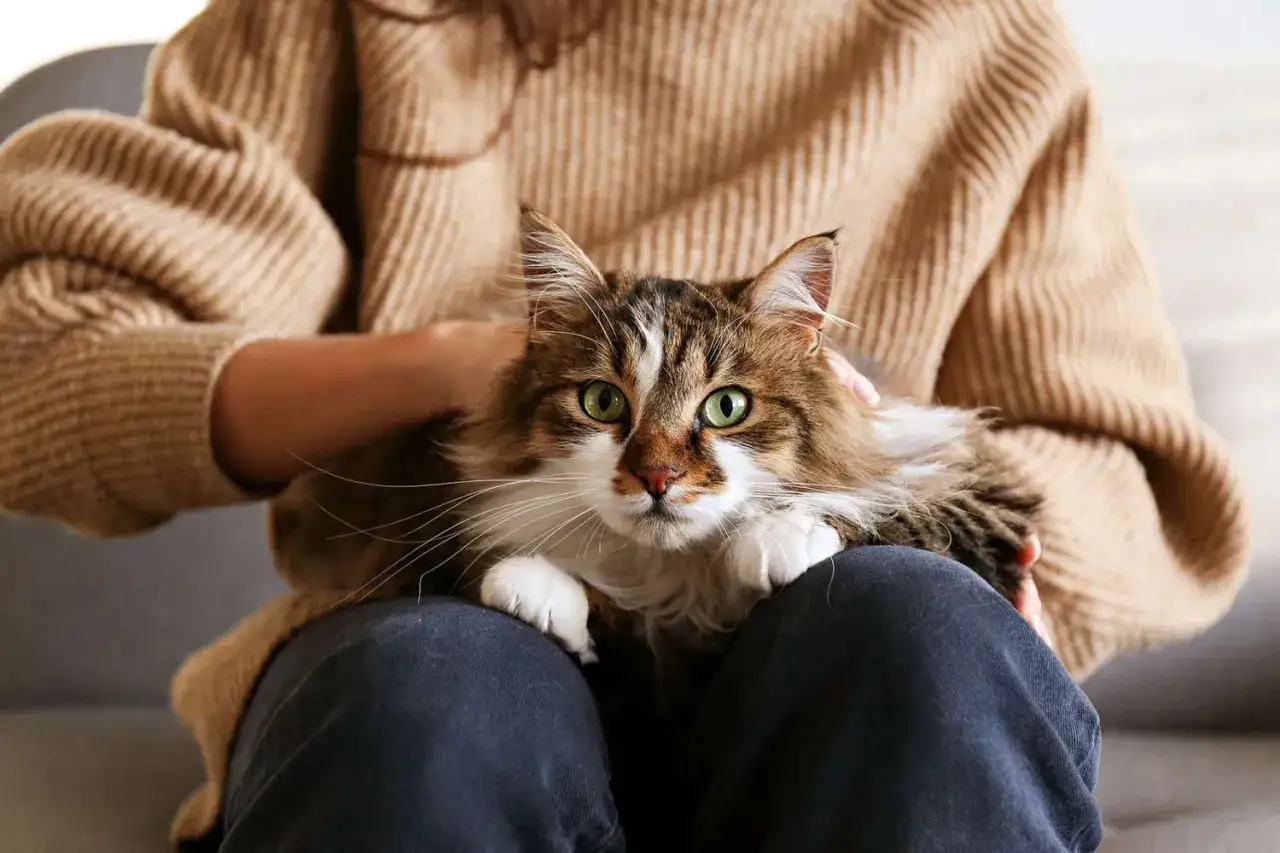
Why your cat does it on you
Your cat is not kneading you because you are convenient, at least not only because of that. Your lap is warm, steady, and usually still enough for the motion to feel satisfying. Just as important, you smell familiar, and familiarity matters a great deal to cats.
I also think there is a social message in the habit. Cats build comfort through scent and repeated safe contact, so kneading on a person often sits alongside head rubbing, slow blinking, and choosing to nap near you. Some people describe it as a kind of ownership, but I would be more careful than that. The stronger message is usually “I feel safe here”, with a possible scent-marking element from the paw pads as a secondary detail rather than the main story. That distinction matters, because it keeps us from over-reading the behaviour as dominance or territory in the crude sense. Next, the rest of the body tells you whether this is pure contentment or something a little more mixed.
What the rest of your cat's body language is telling you
Kneading means very little on its own. I always look at the whole cat before I decide what the behaviour means, because the paws can look affectionate in one moment and overstimulated in the next.
| Body language | What it usually suggests |
|---|---|
| Loose body, half-closed eyes, purring | Contentment, safety, and a cat that has fully settled |
| Kneading with head rubbing or cheek pressing | Social bonding and a comfortable, familiar relationship |
| Kneading with drooling or suckling fabric | Deep relaxation or a strongly kitten-like self-soothing habit |
| Tail flicking, flattened ears, tense back, sudden nip | Overstimulation or discomfort rather than pure calm |
If the posture stays soft, the pawing is usually a compliment. If the body tightens, the tail starts lashing, or the cat seems to switch from relaxed to sharp in a few seconds, the behaviour is no longer just a cosy ritual. That is the point where management matters more than interpretation, which brings us to the practical side of sharing a lap with an enthusiastic cat.
How to make lap kneading more comfortable
My first rule is simple: keep the comfort, reduce the damage. You do not need to stop the behaviour to make it easier to live with. In most homes, a few small adjustments are enough.
- Use a thick blanket or folded throw on your lap so your skin is not taking the full pressure.
- Keep your cat's claws trimmed if they tolerate it, or ask a vet nurse or groomer to help if you are unsure.
- Redirect the habit onto a cushion or blanket rather than your clothes or legs.
- Stay calm and move your cat gently if the paws become painful, rather than pulling away suddenly.
- Do not punish the behaviour, because you are much more likely to damage trust than to change the habit.
There is also a practical detail many owners miss: cats often knead more when they are about to sleep. If your cat only does it at bedtime or when you sit still on the sofa, that is usually just part of a predictable routine. The more important question is when the routine stops looking predictable and starts looking like a change in behaviour.
When kneading deserves a closer look
Most kneading is normal. I start paying closer attention when the pattern changes suddenly, becomes frantic, or appears alongside other signs that something is off. In behaviour work, a displacement behaviour is a normal action that shows up when a cat is conflicted, tense, or under pressure, so a sudden change in kneading can sometimes tell you more about stress than affection.
These are the situations that make me pause:
- Kneading starts or stops abruptly without any obvious reason.
- The cat seems stiff, sore, or reluctant to jump onto the sofa or bed.
- There is hiding, reduced appetite, or less interest in play.
- Kneading is paired with overgrooming, agitation, or repeated biting.
- The cat looks tense rather than settled, especially if the tail or ears are showing discomfort.
If your cat is older, sudden changes can also fit with arthritis or another painful issue, even if the kneading itself is still technically possible. When in doubt, I would treat a behaviour change as a reason to check in with a vet rather than assuming it is just a personality shift. Once health and stress have been ruled out, the simplest explanation is often the right one: you have a cat that feels safe enough to make biscuits on you. That leaves one final practical question, which is how to keep the habit pleasant day to day.
How to keep the habit sweet instead of scratchy
My approach is to make kneading easier to enjoy, not to suppress it. A dedicated blanket, a calm cuddle routine, and a little bit of claw management usually solve most of the friction without taking away the behaviour itself. If your cat chooses your chest, arms, or legs, I would not fight that bond; I would just make the landing zone softer.
- Keep a favourite blanket where you usually sit so the cat has a clear target.
- Reward blanket kneading with attention, so the alternative surface becomes part of the routine.
- Watch for patterns that connect kneading with stress, hunger, bedtime, or changes at home.
- Ask for veterinary advice if the habit becomes obsessive or changes in a way that does not fit your cat's usual personality.
When you treat kneading as a normal part of feline communication, it becomes much easier to enjoy the affection without misreading it or getting scratched in the process.
