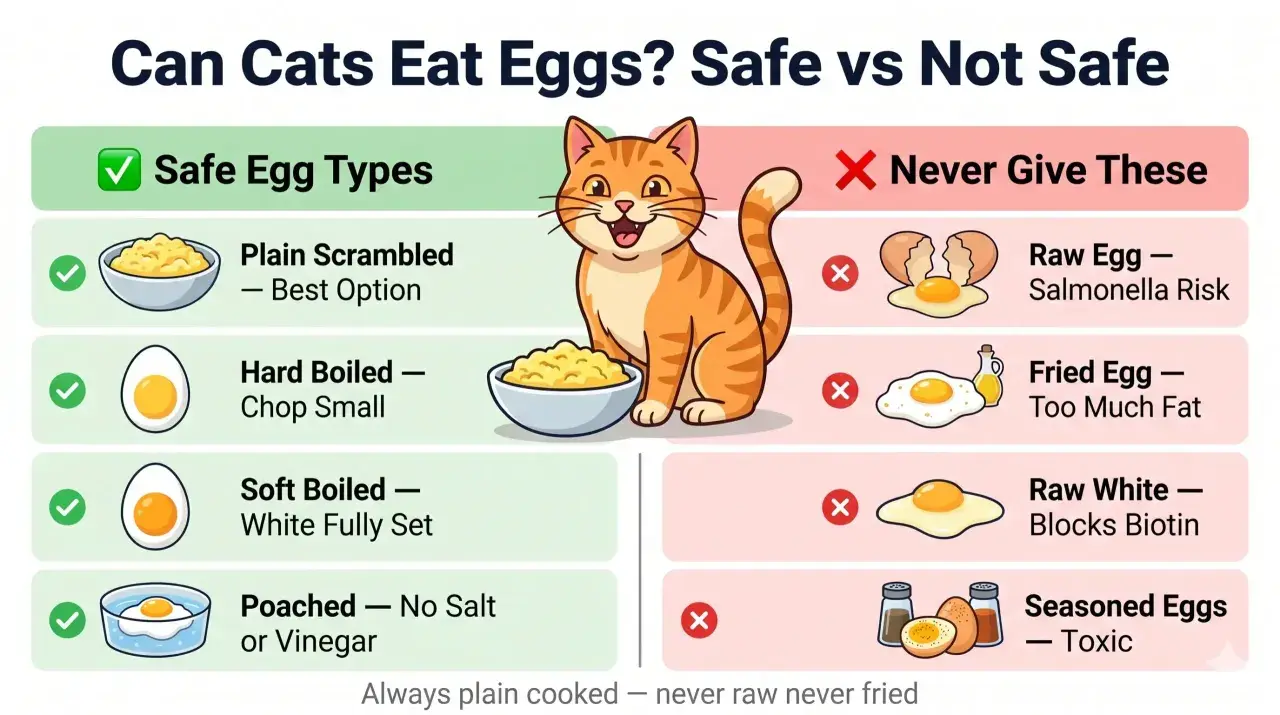
Eggs can be a useful treat for cats, but only when they are cooked, plain, and kept small enough not to crowd out a balanced diet. The real questions are how much to offer, which parts are sensible, and whether raw egg belongs anywhere in the bowl. I’ll break down the benefits, the risks, and the safest way to serve it in a normal home.
The safest way to think about eggs is as an occasional topper, not a meal
- Cooked eggs are fine in small amounts, especially boiled, scrambled, or poached with no seasoning.
- Raw eggs are the version to avoid because of Salmonella risk and the biotin-binding protein in raw whites.
- Egg white is the leaner choice; yolk adds more fat and calories.
- Eggs do not replace proper cat food, because cats need a complete and balanced diet.
- A tiny portion is enough; if your cat reacts badly, stop and reassess rather than pushing through.
What eggs actually contribute to feline nutrition
Cornell’s feline nutrition guidance is clear that cats are obligate carnivores, which means they rely on nutrients found in animal products and need far more than just protein. That is the right frame for eggs: useful, yes, but never a stand-in for a complete diet. I look at eggs as a protein topper with some extra fat and micronutrients, not as a food that can carry the whole nutritional load.| Egg part | Practical take | Why it matters |
|---|---|---|
| Cooked whole egg | Okay in a very small amount | Provides protein, but the yolk raises fat and calorie content |
| Cooked egg white | Best option for most cats | Mostly protein, with very little fat |
| Cooked yolk | Use sparingly, or skip if your cat is overweight or sensitive | More calorie-dense and richer than the white |
| Raw egg | Skip it | Higher Salmonella risk, and raw whites can interfere with biotin absorption |
| Eggshell | Do not use routinely | Mineral supplementation should be vet-led, not guessed at home |
The main takeaway is simple: eggs can add something useful, but they do not add enough to justify sloppy feeding. That leads straight to the bigger question of safety, especially if raw egg has ever been treated as “natural” in the household.
Can cats eat eggs safely?
Yes, but I would only give that answer to fully cooked egg. Raw or undercooked egg brings an avoidable Salmonella risk, and raw egg white also contains avidin, which can interfere with biotin absorption if it becomes a habit. UK food-safety advice still treats eggs as a Salmonella concern, so I would not use runny or raw egg as a regular cat treat, even if that feels normal for people.
Cooking removes the main problem and leaves you with the part that is actually useful: a small amount of digestible animal protein. That said, the easiest way to turn a safe ingredient into a poor choice is to prepare it like a human breakfast plate, which is where portion and preparation matter.

How to prepare egg for a cat at home
- Use plain boiled, scrambled, or poached egg.
- Cook it fully, then let it cool before serving.
- Leave out salt, pepper, butter, oil, and any seasoning mix.
- Cut or flake it into tiny pieces so your cat does not inhale or gulp it.
- Serve it as a topper or a few bites, not as the main event.
- Skip the shell unless your vet has specifically asked you to add calcium.
Texture matters more than people expect. Some cats will happily lick soft scrambled egg from a spoon; others want only a few flakes mixed into wet food. I usually prefer the least fancy version first, because plain food makes it much easier to see whether the cat actually tolerates it.
That practical approach also helps you stay honest about the amount, which is where most well-meaning owners go wrong.
How much is sensible, and which cats should skip it
A moderately active 10-pound cat, which is about 4.5 kg, needs roughly 250 calories a day, and a large egg has about 70 calories. That makes a whole egg a meaningful snack, not a harmless nibble, especially if your cat already gets treats or has a tendency to gain weight.
| Cat profile | Practical approach | Why |
|---|---|---|
| Healthy adult cat | A small serving of cooked egg, with egg white as the default choice | Enough to test tolerance without crowding out normal food |
| Overweight cat | Egg white only, and not often | Lower fat and fewer calories than whole egg |
| Kitten | Usually skip unless your vet advises otherwise | Kittens need a complete kitten diet for growth |
| Cat with pancreatitis or a sensitive stomach | Be cautious with yolk, and sometimes avoid egg entirely | Fat can trigger gastrointestinal upset |
| Cat on a prescription diet | Ask your vet first | Extra foods can interfere with a therapeutic feeding plan |
| Cat with a known egg reaction | Avoid eggs | Vomiting, diarrhoea, itching, or over-grooming after egg is a warning sign |
PetMD suggests about 1 tablespoon of egg whites as an add-on to a normal diet, and I think of that as the upper edge of a small serving rather than a target. If I were introducing egg for the first time, I would start smaller than that and watch for loose stools, vomiting, or skin irritation over the next day.
That gives you a workable ceiling. The last piece is the real-world rule I use when a cat is staring at my plate.
The rule I would use at home
My rule is straightforward: if the egg is cooked, plain, and tiny, it can stay in the treat rotation; if it is raw, oily, heavily seasoned, or part of a richer dish, it stays off the menu. Eggs are useful because they are easy, not because they are magical, and I would rather see a cat eating a complete commercial diet with a small egg topper now and then than a home menu that looks healthy but quietly misses the mark.
For most cats, that means treating egg as an occasional extra rather than a feeding strategy. A little can be useful, a lot rarely is, and the safest version is usually the simplest one.
